

By C B Atilson · Reading time: about 4–5 minutes
Dog food labels can feel more complicated than they need to be. Between ingredient lists, percentages, feeding charts, and front-of-package claims, it can be hard to know what to focus on. This guide focuses on the label parts that matter most when choosing or comparing foods for your dog.
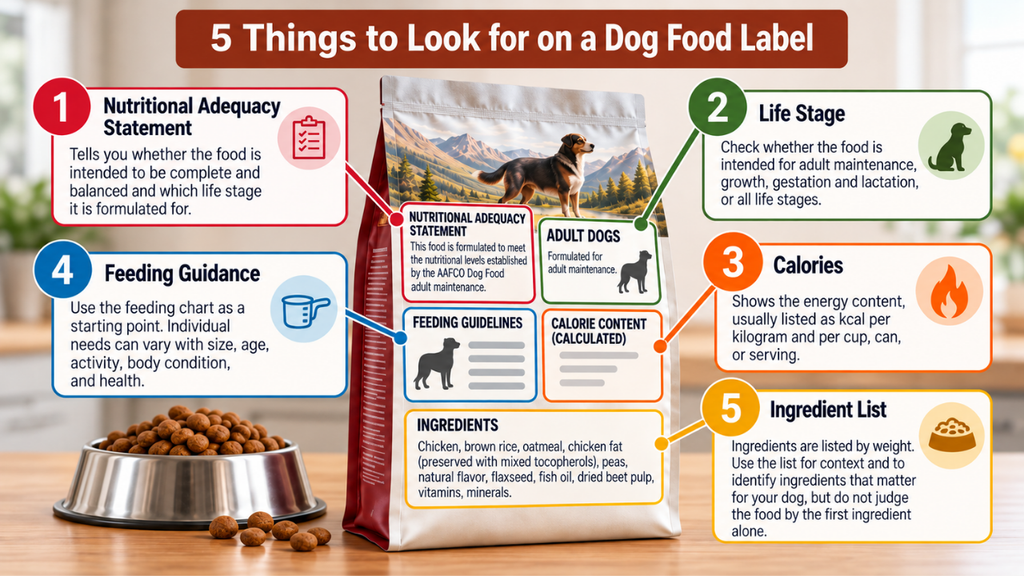
Quick Answer: Check these five things, in this order:
- Nutritional adequacy statement — is it complete and balanced?
- Life stage — puppy, adult, or all life stages.
- Calories — kcal per cup, can, or serving.
- Feeding guidance — a starting point, not a fixed rule.
- Ingredient list — especially when a specific ingredient matters for your dog.

Click the Image to Watch the Short on YouTube.
Start with the Front of the Bag, Then Look Past It
The front of the package is built to grab your attention. Reassuring words, ingredient callouts, and appealing descriptions all shape how a food looks at first glance.
The most useful information is usually somewhere else. Start with what the food is meant to provide, who it’s for, how calorie-dense it is, and how to eat it. Once you know where to look, you do not need to decode every ingredient or percentage.
1. Find the Nutritional Adequacy Statement
This short statement tells you whether the food is intended to be your dog’s complete everyday diet and which life stage it is designed for.
In the U.S., the statement commonly references AAFCO nutrient profiles or feeding tests.
Look for one of these life stages:
- Adult maintenance
- Growth for puppies
- Gestation and lactation for pregnant or nursing dogs
- All life stages
A puppy does not have the same nutritional needs as an adult dog, so this match matters.
Watch for the phrase “intermittent or supplemental feeding only.” It means the food isn’t intended to provide complete, balanced nutrition on its own as an everyday diet.
Pro Tip: Before comparing flavors, protein sources, or package claims, confirm that the food matches your dog’s life stage and is intended for regular feeding.
2. Check the Calories and Feeding Directions
Calories are easy to overlook, but they are one of the most useful numbers on the label, especially when you compare foods or switch brands.
Two foods can look similar in portion size and still provide very different amounts of energy. Look for calorie information such as kcal per cup for dry food or kcal per can for wet food.
Feeding directions help too, but treat them as a starting point. Your dog’s needs can vary with size, age, activity level, body condition, environment, and health.
The amount printed on the package may need to change over time. Use the chart as a reference, then pay attention to how your individual dog is doing.
Pro Tip: Monitor your dog’s body condition over time. If it starts changing noticeably, the feeding amount may need to be reconsidered.
3. Read the Ingredient List, but Not as the Final Verdict
Ingredients are listed by weight, so the first few items naturally get the most attention. But their position on the list does not tell you everything about the nutritional quality of the finished food.
Moisture affects ingredient order. Ingredients with a high water content weigh more, which can move them higher on the list.
Similar ingredients may also appear separately. A recipe might list peas, pea protein, and pea starch separately. Because each appears separately by weight, the list alone doesn’t show the total proportion contributed by related ingredients.
The ingredient list also cannot tell you how digestible the food is or how well the complete recipe meets your dog’s nutritional needs.
That does not make it useless. It can be genuinely helpful when you need to identify an ingredient that matters for your dog. Treat it as one piece of the picture, not the main test of whether a food is a good choice.
4. Understand the Guaranteed Analysis
The guaranteed analysis lists basic nutrient levels, commonly including crude protein, crude fat, fiber, and moisture.
What does “crude” mean? It refers to the laboratory method used to measure the nutrient. It does not mean the ingredient is low quality.
These numbers are useful, but easy to misinterpret. A higher protein percentage does not automatically make one food better than another.
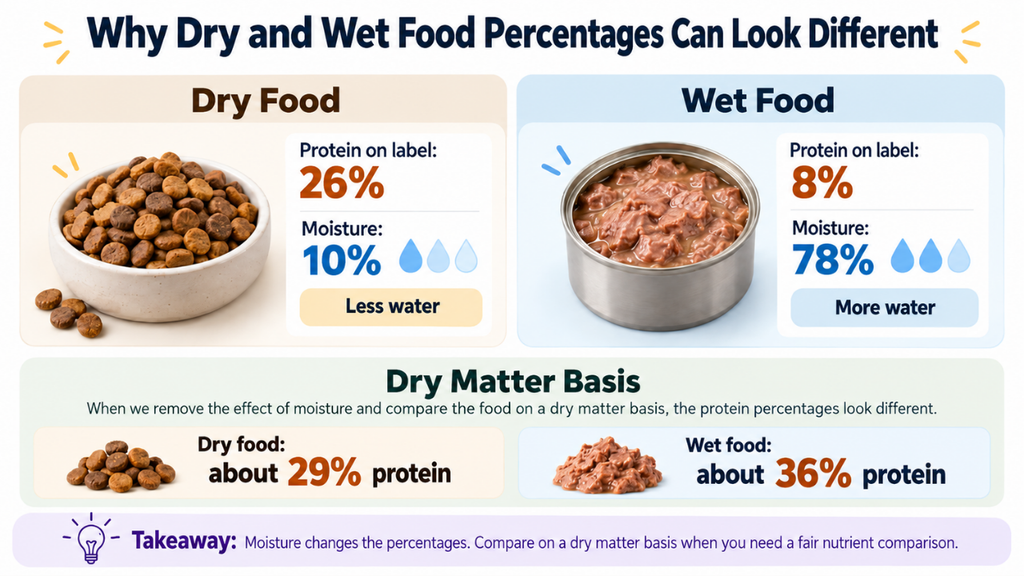
The bigger issue is moisture. The percentages n on the label reflect the food as sold, including water. That makes dry and canned foods difficult to compare directly.
The Moisture Math
To compare foods on a dry matter basis:
- Subtract the moisture percentage from 100.
- Divide the nutrient percentage by the dry matter percentage.
- Multiply by 100.
| Dry Food | Wet Food | |
| Protein on the label | 26% | 8% |
| Moisture | 10% | 78% |
| Dry matter | 90% | 22% |
| Calculation | 26 ÷ 90 × 100 | 8 ÷ 22 × 100 |
| Protein on a dry matter basis | about 29% | about 36% |
The wet food looks much lower in protein on the label, but once the moisture difference is removed, the comparison changes.
Pro Tip: You do not need to do this calculation for every food. It is most useful when you have a specific reason to compare nutrient levels between foods with very different moisture contents.
5. Give the Front of the Package Less Authority
Brands use the front of the package to stand out, with ingredient callouts, lifestyle language, and other claims. Some of that information can be useful, but it should not outweigh the details elsewhere on the label.
Separate what catches your eye from what helps you evaluate the food.
You do not need to ignore the front of the bag. Just give the less flashy information a little more authority.
Questions to Ask the Manufacturer
If you still have questions, contact the company. Useful questions include:
- Who formulates the food?
- Is a veterinary nutritionist involved in formulation?
- Is the food tested through feeding trials, formulated to nutrient profiles, or both?
- Where is the food manufactured?
- Can the company provide a fuller calorie and nutrient breakdown?
A manufacturer should be able to answer reasonable questions clearly about how it formulates and produces its food.
When to Talk to Your Vet
A label can only tell you so much.
If your dog has a health condition, significant weight change, suspected food sensitivity, or other specific dietary needs, the label alone may not provide enough information. That’s when your veterinarian can help you make a more personalized decision.
The Bottom Line
A dog food label becomes easier to use once you stop treating every part of it as equally important.
Start with what the food is intended to provide. Then check the life stage, calories, and feeding guidance. Look at the ingredient list and nutrient percentages with that context in mind.
The label is not the whole story, but knowing where to look makes choosing and comparing foods much less confusing.
Want more practical dog-care guidance like this? Subscribe to Spiky Woofs for new issues and everyday tips for living with your dog.
Frequently Asked Questions

What should I look at first on a dog food label?
Start with the nutritional adequacy statement and the life stage. Together, they tell you whether the food is intended to be a complete diet and whether it matches your dog’s life stage.
Is the first ingredient the most important part of the label?
Not necessarily. Ingredients are listed by weight, so that moisture can affect their order. Similar ingredients may also be listed separately. The first ingredient tells you something about the recipe, but not the overall nutritional quality of the finished food.
Can I compare protein percentages between dry dog food levels?
Not directly. Dry and canned foods can have very different moisture levels, which changes the percentages shown on the label. Converting both foods to a dry matter basis gives a more meaningful comparison.
How much should I feed my dog?
Start with the feeding directions on the package and treat them as a reference rather than an exact prescription. Your dog’s actual needs can vary with body condition, activity level, age, and health.
Does “grain-free” mean healthier?
No. “Grain-free” describes part of the ingredient formulation; it does not tell you whether a food is nutritionally better for your dog. Use the same basics covered above to evaluate the food, and talk with your veterinarian if you are considering a diet for a specific health or dietary reason.